The Economics of Recruiting: What Actually Drives Revenue?
What you’ll find in the eBook
A data-backed breakdown of how candidates move from sourcing to placement — and where most recruiting pipelines break down.
The eBook covers:
- Sourcing efficiency by sourcing channel
- Effort required to produce one hire
- Recruiting funnel analysis by engagement model type
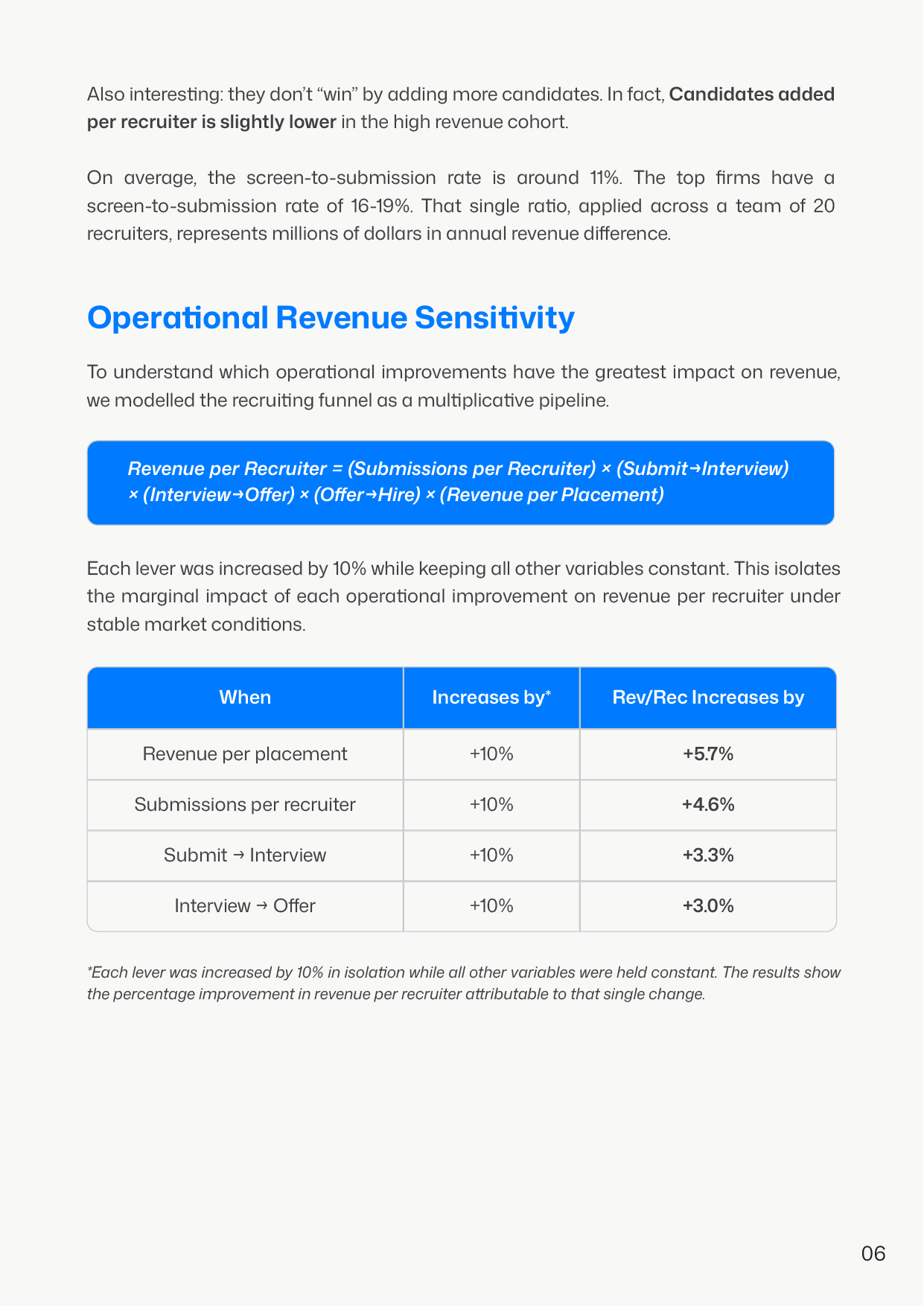
- The impact of improving funnel efficiency on revenue/recruiter
More Sourcing Doesn’t Guarantee More Placements
The industry has been tricked into believing that recruiting is about activity volume. Teams measure success through emails sent, calls made, candidates sourced.
These numbers create a false sense of momentum, but behind the report uncovers a harder truth: Most of that effort never converts into placements.
You can source hundreds of candidates, run dozens of searches, and still fail to generate revenue. Because recruiting is not limited by effort.
It is limited by conversion.
Recruiting Is a Conversion Business
Across millions of candidate records and thousands of placements, a consistent pattern emerges.
- 71% of all placements come from existing database
- The top 25% firms have a much higher internal data utilisation
- Only ~3% of candidates ever reach client submission
- It takes over 200 candidates to produce a single hire
- The largest drop-off happens before a candidate is ever presented to a client
This changes how recruiting should be understood.
Revenue is not created by adding more candidates to the pipeline, but by moving the right candidates through it.
The difference between average and high-performing agencies is not how much they source — it is how effectively they convert.